
Why Barbecue Contests Are Popular

Barbecue contests have been held in many areas and are generally attended by huge numbers of people, competitors and enthusiasts, as well as many people who are more than simply interested in great tasting barbecues of all sorts of meats.
It is important to shifting the perception that these events are only battles of cooks but rather events that embrace talent, togetherness and culture a chief.
From small town carnivals to national recognized competitions, Barbecue Contests entail a mixture of cookery competition, shows of culture, and meeting new people.

A Gathering of BBQ Lovers: Uniting Food Enthusiasts

One of the main reasons why barbecue competitions enjoy great popularity is that they are a great way to gather people.
They became social events where barbecue lovers, call them Aficionados, competitive barbeque cookers and ordinary individuals with an interest in barbq meat taking a long time over a hot fire to cook thus acquiring a rich taste and smell.
A Social Gathering: Barbecue contest creates an environment that is open and welcoming and gives people the opportunity to share stories as they enjoy barbecuing.

Using and Sharing Food Ideas: Participants as well as participants who are competing share recipes, ways of preparing food and grilling, making the general culinary performance splendid to theattendees.
Accommodation of Families and Group of Friends: Most of the contests are conducted with live music bands or other performances and fun filled fun activities that are suitable for families, or group of friends or both.
These yield various stations showcasing regional specialties like Texas BBQ, Carolina style, and Kansas City BBQ among other forms whereby people get to taste a variety to the products of a given style.
These events are not just great barbequest but an experience meant for professional or novices to have fun.
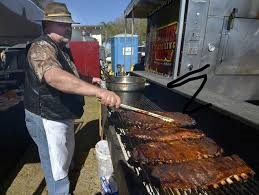
Texas BBQ

Promoting the Economy: Economic and Cultural Social Effects

Barbecuing events serve not only to provide mouth-watering smell of grilled meat but also have a beneficial effect on the economy and people’s pride.

  • Job creation: Large barbecue competitions create several thousands of participants, and most of them are tourists, thus making an impact for boosting local job creation within the tourism and hospitality industries.
  • Booster to related industries: Many small enterprises such as the local food retailers, farmers, and business enterprises that supply the BBQ ingredients gain by having their products sold in large quantities during these events.
  • Raising National Profile: Memphis in May and The American Royal World Series of Barbecue attracted and boosted whole cities’ recognition and sales and promotional sponsorships.
  • Employment: BBQ contests also help in creation of employment, as most are tendered through event staffing, food vending or promotional activity, which is helpful to the local workforce.
  • Promoting Local Values: Some contests have a cause related aspect where the money earned is given to a local charity, food bank or to help the cause of disaster-stricken areas, which enforces the value of supporting one another.

Essentially, BBQ contests can be seen as a tool that can convene the population under the auspices of entertainment and good food while at the same time working towards financial sustainability and progress.

Common Mistakes to Avoid in BBQ Competitions

It is very easy for even those exquisite pitmasters to form what may deem fatal decisions that would bring some losses in the contests.
By knowing them, it will aid the competitors to be more aware of their strategies as well as prevent them from making fatal errors.

Overcooked or Undercooked Meats

This is the case because overcooked meats can be dry, chewy or crumbly, hence making anyone who is eating them uncomfortable.
Thus, bristle that disintegrates or ribs that easily pull away with no need of pressure are deemed overcooked.

Recal the feeling when you chew an undercooked meal; it is awful, hard and at some instances it is not suitable for human consumption.
Acutely, the judges expect the meats to be well cooked tender meats to the tenderest while at the same time chewable.

First and foremost for the purpose of obtaining that perfect doneness, one has to use a meat thermometer and be very keen on the internal temperature.

Another problem that may be associated with sauce is using too much or too little of it, which matters in achieving the right flavors of the food.

Sauce should be used as an enhancer or a garnish to the food and not as a major component of it.
For instance, over-saucing tends to draw the attention away from real flavor of the meat through seasoning and seclusion as well as smokiness.

On the other side, the dish may be overcooked if there is little or no sauce applied to the entry, and this usually lacks taste and is watery.
A light coating or a rather moderate layer is probably the most suitable for such a goal.

Not Following Contest Rules

The rules that are strictly anticipated in every barbecue contest include the kind of meat to be used together with the methods used in preparing them to the time taken on the preparation process. This is due to the reasons that failure to adhere to any of the rules may lead to elimination or poor performance.

Certain contests entail a submission to be made in an appropriate receptacles or in certain portions.
Since there are several types of requirements there are also several penalties for ignoring them.

Each of the judges also insist that meats to be served be properly cooked on the same premise.
This publications included prohibited pre-cooked meat and pre-marinated meat hence, any kind of meat that is pre-cooked or pre-marinated will attract disqualification of the competition.

If these mistakes are avoided and the competitors are only aligned with the following judging criteria, there will be high chances for them to win in the competition.

To be able to achieve the best results while barbecuing, one has to work hard, practice as well as have adequate knowledge of what the judges are likely to consider as the best.
A barbeque competition will favor contestants who have mastered the capabilities of their barbeque tools, tasted many foods and developed ways to prepare their meals so that they will end up having a barbecue champion.

barbecue champion

Taste: The Ultimate Deciding Factor

The type of flavoring used in a winning barbecue dish should be symphonious to ensure that complementary flavors are produced.
Judges also look at the balance of the seasoning, smoky character and the natural taste of meats involved.
When the taste is too powerful, like in the case of spiciness, or saltiness or sugar, this will also adversely affect the score.
The key ingredient here is that considerable amounts of both savory, sweet, smoky, and a twig of tangy should be achieved.

Products that are smoked are defined by how the wood that is used to conduct the smoking process is selected and this paper is a confirmation of that.
It is worth mentioning that greens like hickory, mesquite, applewood, and cherry give varying measure of smokiness that must complement, not mask, the meat flavor.
Sauce is very essential, but they should not overpower the real flavor of the meat.
All that some of the judges like is the thin layer of sauce, the others like an actual glaze on top of the dish.

Tenderness: Achieving the Perfect Texture

The meat should be firm to a certain extent but not tough or soft and pulpy in texture.
The pits themselves are judged for their appropriateness to the category present, this may include, brisket, ribs, or pulled pork.

The Internal temperature of brisket should be at about 195 degrees Fahrenheit; when bitten into, the texture should be juicy, but should not be able to cut easily.
Ribs should be easily wanting to be cut or bitten – when bitten, it should have a clean bite mark, when chopping, it should not separate itself easily from the bone but should pull off easily with the bone attached.
Pulled pork, therefore, should be tender and juicy and not tough or hard to cut: instead, it must be easily shred by a fork.

Appearance: First Impressions Matter

Cooperating judges sample the dishes and assess the presentation features of the dish that they are to taste.
Organization is important in scoring since a well arranged plate shows that the competitor cared in arranging her or his plates.

Information includes matters of taste and texture; meat should have an appealing color; a dark brown or caramelised type of appearance, although not scorched.

Arrangement of the grill marks, even slicing, and a gleaming coats of the sauce enhance the overall outlook of an entry.

It should be noted that garnishing should not be excessive as it detracts from the focus on the actual meat.

three aspects and win high scores and gain the favor of the judges inside the competition venue.